Friday, 14 June 2013

ABDULKAREEM KASID AT THE BRITISH LIBRARY


To the BL last week, to record, alongside his reading in Arabic, some of the English versions of the London-based Iraqi poet's poems that I've been making with him over the last two or three years. He's on my right. The Punjabi poet Amarjit Chandan, who conducted the interview with Kareem accompanying the reading, is on my left. The photo was taken by curator Stephen Cleary. 

The series is 'Between Two Worlds: Poetry and Translation'. It is an  audio recording project conducted by the  Library in collaboration with Amarjit Chandan. The aim is to to record for posterity a wide range of poets who are bilingual or have English as a second language, or who otherwise reflect the project's theme of dual cultures. Most of the poets selected have migrated to the UK from the countries in which they were born.

The format is a reading of a selection of poems followed by an interview on the personal experiences and situations that may have influenced the poet's creative work. There over thirty poets recorded so far. You can listen to the readings on the Library's website. Abdulkareem Kasid's recording should be there soon.

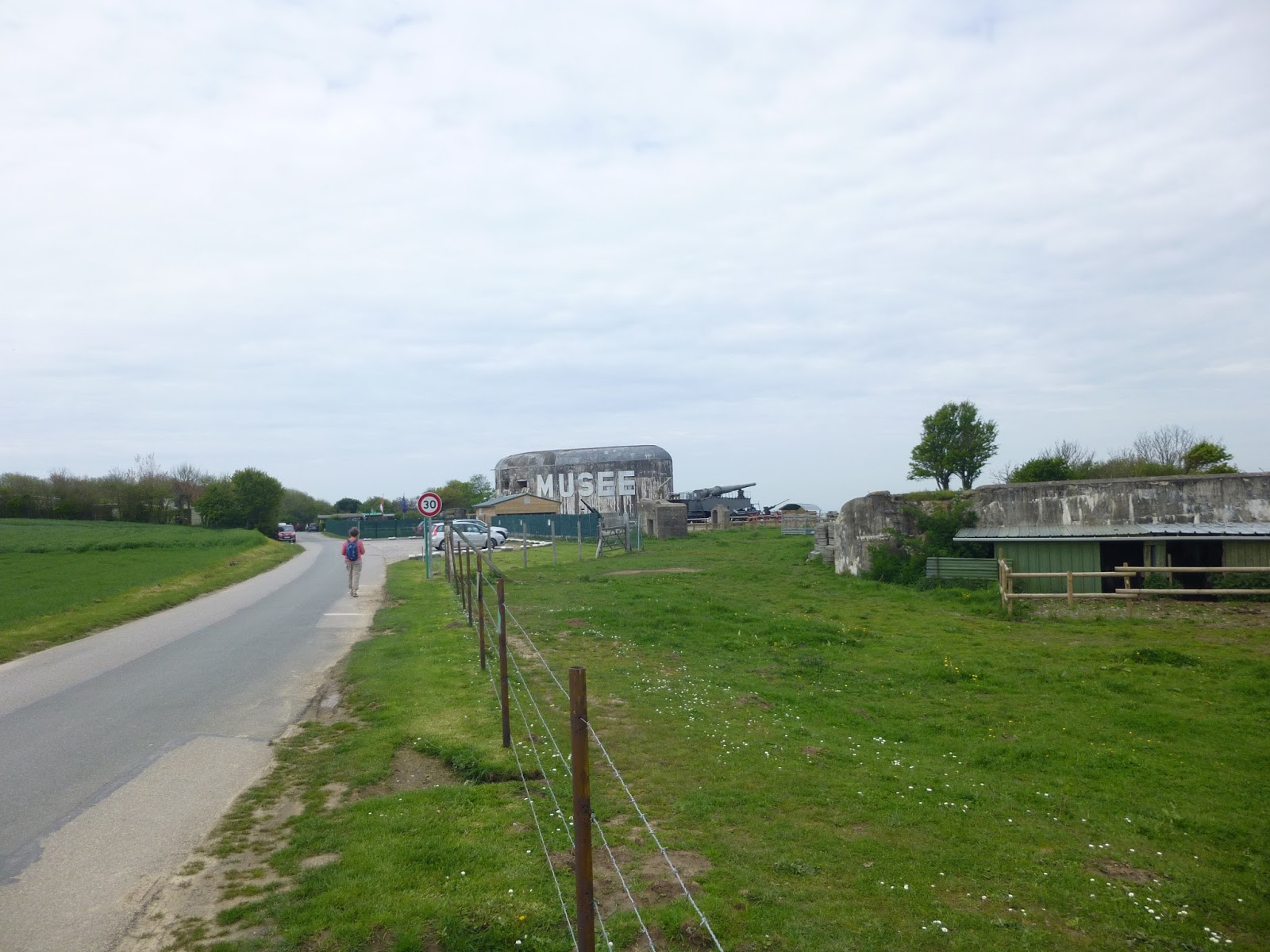
TODT MUSEUM


Museum as fortress? Something for the heritage industry? It's about ten miles from Calais and near where we had a family holiday three weeks ago, in an area thick with Second World War memorabilia. Mr Todt was chief architect of the German motorway system in the 1930s. He was employed to design this massive gun emplacement, to house a gun pointing directly towards Dover. And now it's private museum, the work of an individual enthusiast. It's an enormous space inside, with lots of weapons and some puzzling signage: 'The funboards are specific to this site . . .' In one glass case there's an RAF string vest as issued apparently to all pilots, the idea being that when you were taken prisoner you unravelled your vest and used it as a rope to climb down from your cell. Can this really be right?

‘THE PALACE IS VAGUE AND DELICIOUS’

Going through old files on my computer I came across this. I've long been preoccupied with Domenicino's Frescoes for the Aldobrandini Villa, many of which are in the National Gallery (where, when I last enquired, they could only be seen on Wednesday afternoons and not always then). The scenes are depicted as if on tapestry hangings and the most famous shows a burly, dwarf staring out at the spectator holding his manacled wrists in front of him. Researching them took me to an Italian site. I clicked on Translate and this came up. . .

Algid mount, under which form a small lake near the Latin way, called the Lago of the Quarry, or the Size of Rocca Priora. Reached the villa Lookout, servants for the giuochi of water, than ivi in great number make themselves, which were perfect to you from Orazio Olivieri di Tivoli, Engineer of the villa of Este. The palace is vague, and delicious much its situation, than ago to give the name of Lookout. 

Four but of these facts more do not exist, being be it saws to you, and it transports to you in Rome, these are three the by hand skillful one in entering, and that one on the door. In bottom a rappresentazione of the mount is looked at Parnassus in relief, on which they are Apollo, and the MUSE, ciascuna di.le which sound a istromento for the force of tlie water, and forms with a music concert. 
In the same palace then veggono ne' express ceilings several facts of the Writing, paintings to coolness, do not give the Domenichino, as it is grossly expected; but from the Knight of Arpino, and quantunque, according to the usual, works of a corrected design cannot dirsi, also deserve of being seen, being of the best ones than that artist. 
In the following room Davidde is represented, that the Golia Giant kills; and finally in the last room Giuditta observes itself continuation from its slave, than door the head of Oloferne. The figure of Giuditta is of one amazing beauty. As far as the merit, like garden, it is on the taste of the other villas of Italy; but the delicious situation, in which it is found, very influences not to remain displeased seeing the trees cuts to you in several shapes on purpose. 

Friday, 18 January 2013


'BEING IN THE STUDIO WITH HACKNEY DOWNS'


This is Amanda Welch's account of her Hackney Downs project, which she has been working on for the last three years or so. The book is out now, and she writes: 

The open-ended process of making memory drawings recording my frequent bicycle trips across Hackney Downs was the starting point for the Hackney Downs work. The relationship between the drawings and the paintings and constructions which followed was not a straightforward one. The drawings were memory jottings. They were not ideas for paintings. At first every attempt to make ‘art‘ out of the drawings seemed a betrayal of their nature. Eventually I did find a way of working directly which, instead of developing ideas from the drawings, in a sense paralleled their ad hoc, ‘non art‘ method of construction. I have tried to tell the story of this journey in my book. The book could be said to be its concluding work.
                                            

'It was really strange, when I first went through that door into her studio, I felt a bit dismayed – at first sight everything looked amateurish and self-indulgent, but then, as soon as I started looking around and she started talking about the work it became so witty and engaging and stylistically quite sophisticated but in a very unpretentious way. She really does have a feeling for paint and materials and a way of including text and such a great sense of humour . . . So much stuff I see now seems to bear no relation to how people live their lives or what really matters, but Amanda seems to have caught it in the most natural way.'
                       Rosemary Haworth-Booth

More information on Amanda Welch's website: www.amandajanewelch.com

62 pages 25cm x 20cm with 90 full-colour illustrations.  £12.50 + £2.35 p&p. Available from The Many Press. Enquiries to johnhopewelch AT yahoo.co.uk

Saturday, 5 January 2013

CAFES


Photographs by Amarjit Chandan


CAFES

A new Many Press publication, the first for ten years, this is the first extensive publication of London-based Iraqi poet Abdulkareem Kasid’s work in English . . . Well-known in the Arab world as a poet, essayist and translator – in total he has published around forty books – he was born in Basra in 1946. It was in 1978 that he left Iraq and fled to Kuwait. To avoid being found and sent back he left Kuwait for Yemen, where he settled in Aden and worked as an editor of the New Yemeni Culture magazine. He was living close to the house in which Rimbaud lived – appropriately enough, as he has translated Rimbaud into Arabic. Between 1980 and 1990 he lived and worked in Damascus. 

There are different poetic worlds in London that scarcely overlap and this seems a pity. In my introduction to Cafés I’ve written: Abdulkareem Kasid is part of that Arab diaspora which carries on a rich and varied cultural life in this country but which only sporadically comes into more general view. A collection by another London-based Iraqi exiled in London, Songs of the Tired Guard by Buland al-Haidari, appeared way back in 1977. It was translated by Abdullah al-Udhari, who published it with his own TR Press. Al-Haidari died in 1995. Still resident in London is Saadi Youssef, whose selected poems Without an Alphabet Without a Face, translated by Khaled Mattawa, appeared from the American publisher Graywolf Press in 2002 

The café as a site of sociability and meeting place for writers . . .  It features significantly in the work of Fawzi Karim, another London-based Iraqi poet, whose collection Plague Lands appeared last year from Carcanet, in versions by Anthony Howell and Abbas Khadim. 

Cafés has two poem sequences. In the title poem the short sections have, paradoxically in view of the underlying subject matter, a certain lightness of touch, but always edged with darkness.  ‘Windows’ treats its themes of oppression, nostalgia and flight in a manner that is oblique and enigmatic.

Translating poetry nowadays is often a collaborative affair. The title sequence was first translated into French by Kader Rabia. I made an English version of the French which was then worked on in close consultation with the poet. The sequence ‘Windows’ was translated by the poet working with his daughter Sara Halub and this version was then worked on by David Kuhrt, again in close collaboration with the poet.

Cafés is available for £3.50 and if you’re interested in a copy you can contact me at 
johnhopewelch AT yahoo.com 


From Cafés

A café near the bridge – 
At daybreak
The boats call there.
They wait and wait
Then set off again, empty
Moving without oars
So where could those boats be going?


A café, when I was a child
And all I can remember
Is a white fox fur
Hanging there when you went in.
Eyes closed it had a child’s face, 
And shadows blown this way and that by the wind – 
A café which, no doubt, existed 
Only in my dream


The boat, that cast anchor 
In the river, alongside the market,
It’s no longer a boat
Since summer surprised it with whiteness 
And the chairs were lined up on its deck
And the passers-by came on board
No longer waiting  
For its siren to sound.


From Windows

Open in summer,
closed in winter.
In autumn 
I don’t know 
why I close them
or open them,
in spring 
I don’t remember 
what I should do.


Once I carried my luggage
And walked away
followed by windows. 


What windows are those 
smelling of vinegar  
and my mother’s fragrance! 


In the desert there is a window. 
Why has no-one seen it 
but me?


There,
on a distant path,
in mountains that are merely memory
where waters run vaguely, 
one small window 
looks out. 


This man  
carries his window with him
as he walks


BILL SHEPHERD

The poet and translator Bill Shepherd, who always published as W.G.Shepherd, has died. He died at his home in North London in October. He was seventy-seven. I’d known him well ever since we both attended a discussion group that met at the poet Anthony Howell’s Hampstead flat at the beginning of the 1970s. Assiduous in sending out his work, Bill was in other respects quite reclusive as regards the poetry world, hardly ever going to or giving readings, or seeking to engage in any of those ancillary activities that nowadays take up a lot of many poets’ time and which seem to constitute what it means to be a proper, ‘professional’ poet. 

I published three chapbooks of his poems under my Many Press imprint. These were The Antonine Poems (1976), The First Zone of the Growth Furnace (1983) and The Gifted Child (1991). For many years Bill’s main publisher was Anvil. They brought out a pamphlet Allies in 1968, one of their earliest publications and three more collections followed. 

Characteristic of him was his independence, his open-mindedness, a readiness to move off in different directions. As a result of Anthony Howell’s workshop his writing took a rigorously experimental direction. ‘I was made up by Jeremy Prynne’ he told me once, a phrase to conjure with .. . They were contemporaries at Jesus College in the 1950s and the reference was to their participation in a college dramatic performance. He was in correspondence with Prynne many years later in connection with this area of his work. Subsequently he was to write some very powerful confessional poems, some of which I published in The Gifted Child, and which are the substance of his last collection Mother’s Milk which appeared from Tony Rudolf’s Menard Press in 2006.

Bill’s move into translating was an unexpected departure – he only had A Level Latin but, having become intensely preoccupied with translating Horace, he did the Odes and Epodes, and went on to translate Propertius. These both became the versions published in the Penguin Classics series. He was working full-time in industry and, as he described it to me, it was like being possessed. His final venture in Latin translation was his ‘Statius: Silvae’ done jointly with Anthony Howell and published by Anvil in 2007. The combination of two translators with their separate points of view, and in one case each offering versions of the same poem, is illuminating. 

The last time I actually saw Bill – we were regularly in touch on the phone subsequently – was during the Summer. He had just come through an exceptionally gruelling course of radiotherapy and chemotherapy. It was a fine afternoon and we sat in the garden. I recall him sitting very upright on his chair, wearing a baseball cap, and recounting a brief ‘psychotic episode’ he’d had in the hospital as a result of all the medication he’d been having as well as a period of prolonged sleeplessness. The first part of this was something terrifying – I don’t remember the details – but later he became convinced that everything that was going on around him was all one enormous entertainment put on just for his benefit. Bill was no stranger to extreme psychological states but this was all narrated in the same humorous way  as the way in which he tended to observe ‘the poetry world’. It can be a paranoid place, and sometimes you feel that just about everybody, including some people you would least expect it of, feels under-appreciated. Bill appeared unusually free of all this and his take on it all was refreshingly open-minded and humorous. 

Copies of W.G.Shepherd’s three Anvil collections are still available. 'Mother's Milk' is available from the Menard Press. I can supply copies of ‘The First Zone of the Growth Furnace’ and ‘The Gifted Child’.

Here are five of his poems . . . 


THE MEANING 

In Zeus' oak at Dodona 
Pigeons privately murmur. 
No breeze blows 
Yet foliage whispers. Every leaf 
Is written upon. 
Ears detect or imagine 
In the spring's trickling 
A slight modulation. 
The girls called 'pigeons' tap 
(At random?) on gongs. 
The interpretation 
Is cryptic makeshift, 
The oracle plain. The meaning 
Is what an oak tree means. 


JADE
Diamond glances grow dull.
Springtime hurt
With pleasure but memory dims.

Rainbow dalliance fades
In her wardrobe. Summer is null,
Autumn a burden.

Bloom on peach degrades
To dust on eggshell. Mirrors peer.
He works far away . . .

Cyclamen porcelain
Petals for nails
Tip ladylike hands.

Wine and fright
Shake fingers plucking from foil
Her sunset capsules.


PRIVACY
To impersonate the heron god
was more effective than prayer.
A feathery man on stilts
was glimpsed in the marshy wood
towards first light.
Boudicca was defeated by magic.

Hectic monkeys jump nerves,
nerves, in surprising green fur.
Parrot kaleidoscopes heckle.
Insect electrons glitter.
Through graveyard railings the owl
blinks honest, absolute eyes.


TROUBADOUR
Radioactive
Lightning greasy with rain:
His outcry was
Songs like the Hamburg mail
The Abelard generation


GUARNERIUS
She was prepared to believe
The fraudulent label – it was her father’s violin
But they said, ‘you must learn the piano
First.’ She crossed her fingers
In the name of Guarnerius, Guarnerius is in heaven,
No kin to the keyboard with its ready-made notes,
She reneged – they would impose
A kind of nunnery discipline.
She climbed instead the domestic Eiger face,
Doing the thousand things that have to be done. 


Friday, 4 February 2011

ANAESTHESIA'S HERITAGE

I was walking down Portland Place the other day and there it was, a big handsome brass plate: ‘Anaesthesia Heritage Centre’ Opening hours were given but with this caveat: ‘An appointment is recommended.’ Well you would need one wouldn’t you? The website recommends ‘Blue Plaques and Buildings: a history of anaesthesia walk around London’.

Ah yes, the ‘anaesthesia of heritage’. I first came across this institution on Beverly Rowe’s website where, among other things, he has an extraordinarily comprehensive list of museums in London. I’m sure it was the ‘Museum of Anaesthesia’ then, but we must move with the times. When I was teaching in East London, pupils’ ‘mother tongues’, Bengali, Punjabi or any number of others, were referred to in official documents as ‘heritage languages’. It’s a deeply ambiguous term.

Raymond Queneau is part of the ‘heritage of modernism’ I suppose. Beverly Rowe has updated his diabolically ingenious English versions of Queneau’ sonnets. He writes: You can now get new randomly-selected sonnets at a set interva. I describe it as a slide show. When you select that option, the poem is refreshed every two seconds but you can change the interval. . .With the extra sonnets and line shuffling, there are now 261,245,548,225,364,000 possible different sonnets.

I suppose this raises the question whether there is perhaps a ‘crisis of productivity’ in poetic output? I was struck by this comment from Laurie Duggan on his ‘Graveney Marsh’ blog: In its rhetoric of constant innovation it resembles nothing more than the ethos of late capitalism, where redundancy has no connection with utility.

Sunday, 30 January 2011

AMHURST REPUBLIC

Amhurst Republic where no one is illegal . . . well it’s in Amhurst Road in Stoke Newington, just round the corner from me, and it was launched the other day with a party in artist Souheil Sleiman’s studio. (It’s Souheil’s sculpture ‘All Dressed Up and Nowhere to Go’ that appears on the cover of my most recent Shearsman book, ‘Visiting Exile’). It was a great party and you can see and read more at http://www.amhurstrepublic.wordpress.com/.

Wednesday, 26 January 2011

ROGER LANGLEY

Resuming this blog after a long break it is sad that the subject of my first post should be the death of the poet Roger Langley, who died suddenly at his home in Suffolk following a heart attack on 25th January. When I spoke to him on the phone a couple of weeks or so ago he sounded energetic and very positive – he was just getting to the end of a course of medical treatment – and his death came as a great shock.

Roger was one of those life-changing schoolteachers. He taught English and Art History at secondary schools in the Midlands and it was Nigel Wheale, a close friend and former pupil, who became his publisher, bringing out ‘Hem’ (1978) and ‘Sidelong’ (1981) under his infernal methods imprint. There was also a pamphlet from Equipage, ‘Jack’, which appeared in 1998. Then in 1994 Nigel published ‘Twelve Poems’ which attracted the attention of Carcanet who went on to publish two collections, ‘Collected Poems’ (2000, and published jointly with infernal methods) and ‘The Face of It’ (2007). This latter includes the poems I had published in ‘More or Less’, which was the last thing I did under the Many Press imprint. There was also a pamphlet, ‘Twine’, which came out from Landfill in 2004.

Roger was among other things a very accomplished draughtsman and there is an extraordinary intensity of seeing in his work, whether engaging with varieties of natural phenomena or with painting. This is evinced everywhere in his ‘Journals’ which appeared regularly in PN Review and in collected form from Shearsman (2006). And there’s an interview, first published as a pamphlet by Peter Riley and then included in Angel Exhaust, which gives a remarkably open and detailed account of his poetic method and practice.

A friend of Prynne’s from student days, a particular talent of Roger Langley's was to combine some traditional English preoccupations - landscape and natural history, visiting country churches - with a rigorous modernism. He was still very much occupied with writing - a poem Nightingale appeared recently in the London Review of Books - and will be sorely missed as a writer and as a friend.

Sunday, 22 November 2009

A STREET ORDERLY SPEAKS OUT

‘I’m 42 now and when I was a boy and a young man I was employed in The Times machine office, but I got into a bit of a row, a bit of a street quarrel and frolic, and was called on to pay £3, something about a street lamp; that was out of the question; and as I was taking a walk in the park, not just knowing what I’d best do, I met a recruiting sergeant and enlisted on a sudden . . .’ Thus the street-orderly, interviewed by Mayhew for his ‘London Labour and the London Poor’ published in 1851. This interview is not one of these used by poet John Seed in his ‘Pictures from Mayhew’ and ‘That Barrikins’, published by Shearsman - but it does have a certain contemporary relevance.

‘I served under General Nott all through the Afghan war’ the man tells him. ‘Why yes sir, I saw a little of what you may call ‘service’ . . . I was at the fighting at Kandahar, Bowlingglen, Bowling Pass, Clatigillsy, Ghazni and Kabul. The first real warm work I was in was at Kandahar. I’ve heard young soldiers say that they’ve gone into action the first time as merry as they would go to a play. Don’t believe them sir . . . You must feel queer and serious the first time you’re in action: it’s not fear, its nervousness. The crack of the muskets at the first fire you hear in real hard earnest is uncommon startling . . . And then you get excited, just as if you were at a hunt, but after a little service – I can speak for myself at any rate – you go into action as you go to your dinner.

I served thirteen years and four months and was then discharged on account of ill health. If I’d served eight months longer . . . I’d have been entitled to a pension. I believe my illness was caused by the hardships I went through in the campaigns, fighting and killing men that I never saw before, and until I was in India had never heard of, and that I had no ill-will to; certainly not, why should I? They never did me any wrong. But when it comes to war, if you can’t kill them they’ll kill you.’

When he came back, he tells Mayhew, he got a job at The Times again ‘but ‘I wasn’t master of the work, for there was new machinery, wonderful machinery . . . So I couldn’t be kept on.’

So now he’s in London sweeping the streets and, like sleep-walkers caught up in some dreadful cycle, a century and a half later we’re back there once again.

LAUNCHES

‘Visiting Exile’, my new Shearsman collection, is now out. On 6th November I read from the book at Souheil Sleiman’s studio here in Hackney. I’ve already described (see five or so posts back) Souheil’s sculpture ‘All Dressed Up And Nowhere To Go’ and its role as a powerful presence in the book. Also on the programme were two short films. Ruth Dupre showed her film ‘Les’, a portrait of a committed smoker. She is an artist specialising in glass who has recently been making films and this is one of a number of film portraits she has done which manage to be very intimate, but non-intrusive. Her ‘Childsong’, a poignant account of an early 19th century educational experiment where a group of children were brought from Sierra Leone to Dulwich where a school was established for them can be seen on the net. Her website is http://www.ruthdupre.co.uk/. Secondly there was ‘Exit’ by Palestinian film-maker Mohanad Yaqubi, a film reminiscent of a performance art piece, set in a totally deserted London Underground, where a dancer enacts a sense of entrapment. And then to finish music from Hyberbolic, a group one of whose members is Souheil’s son.

Then on 15th November Tom Lowenstein and I joined forces to launch our respective collections at Tom’s house in Stoke Newington. Tom’s new book is ‘Conversations with Murasaki', also available from Shearsman.

BOW-WOW AT THE ARTS CLUB

The Bow-Wow Shop, edited by Michael Glover, must be the only web magazine to manifest itself in flesh and blood form with a launch. Issue 3 was launched with readings a few days ago at the Arts Club. A short Ashbery poem read simultaneously in Polish and Russian translation created a pleasing and oddly soothing effect. Among the other readers was Japan-based Paul Rossiter who read an electrifying poem. ‘Komachi’, from the current issue. As well as a group of his poems there’s a substantial afterword by him, ‘Thatched Huts and Instant Noodles’, where he describes in some detail the history of his encounters with Japanese poetry, starting, long before he had visited the country, with his reading of Bunting’s ‘Chomei at Toyama’ . ‘Komachi’ takes off from a contemporary No play he happened on two weeks after arriving in Tokyo in 1981. ‘Traditional No’, he writes, is performed extremely slowly, but that is as nothing compared to the pace at which this Komachi moved. In the second line of the poem I talk about her moving 'centimetre by centimetre' across the bridge, and this is perhaps an understatement; her pace was almost impossibly slow, and it took her nearly ten minutes to cover the few metres to the centre of the stage. Moreover, the production was also almost completely silent; although there was occasionally some music (Vivaldi, 'La Vie en Rose'), and the figures in the sub-plot (squabbling 1980s' neighbours who live in the apartment next door to Komachi's ancientness) had lines to speak, Komachi herself stayed silent throughout the performance. The speechlessness, the extreme slowness of the movement, and the use of No performance practices, together created an extraordinary intensity. The performance was both phantasmagoric and perfectly controlled, and it made even someone like Peter Brook look a bit sloppy. I'd never seen anything like it.’ It sounds like a piece of performance art, and suggests a resemblance that seems to exist between such traditional forms, and Zen, with western modernism. Rossiter’s piece concludes with a hilarious account of cross-cultural endeavour and confusion, again in Tokyo, involving Kenneth Koch and the shade of Amy Lowell.

Friday, 20 November 2009

RIMBAUD IN ADEN

Lunch yesterday at Iraqi poet Abdulkarim Kasid’s flat near Chancery Lane, to continue working on the English versions of his poems, versions he first made himself working with his daughter Sara. This method of translation has become increasingly common of course, and I’ve previously worked on the British-based Punjabi poet Amarjit Chandan’s poems in a similar way. Some of those versions are among those included in a collection of his poems, ‘Sonata For Four Hands’, due out very soon from Arc Press. It’s a way of working of course that shows up a fundamental asymmetry – they know English, we don’t know Arabic, Punjabi . . .

Kasid’s first home after he got out of Iraq nearly thirty years ago was in Aden. He lived near to what was Rimbaud’s house, and one of the poems we’re working on, ‘A Volcano’, is dedicated to the poet’s memory. He has translated Rimbaud from French into Arabic and yesterday he told me he identifies with Rimbaud’s wandering lifestyle, having himself like so many others been constantly on the move through force of circumstance, something alluded to in this poem (which was in Shadowtrain a while back):

TERMINAL WISDOM
How could I know
My outbound journey
Could be the way back,
That my dreams were behind me
And I wasn’t only the walking shadow
Of a standing-still man?

Wednesday, 18 November 2009

STUDIES AT DELHI 1876

Sir Alfred Lyall was nothing if not an imperialist, with long service in the most senior ranks of the Indian Civil Service. The sack of Delhi in the aftermath of the ‘Mutiny’or ‘Great Revolt’, depending on your point of view, when Delhi was retaken, sacked and many of its inhabitants killed, was a particularly dreadful episode. Writing some twenty years later Lyall, in his ‘Studies at Delhi 1876’, evokes a game of badminton being played on the spot where the battle to retake the city had been fought:

Hardly a shot from the gate we stormed,
Under the Moree battlement’s shade;
Close to the glacis our game was formed,
There had the fight been, and there we played.

Lightly the demoiselles tittered and leapt,
Merrily capered the players all;
North, was the garden where Nicolson slept,
South was the sweep of a battered wall.

Near me a Musalman, civil and mild,
Watched as the shuttlecocks rose and fell;
And he said, as he counted his beads and smiled,
‘God smite their souls to the depths of hell.’

Well at least Lyall could see it . . .

Wednesday, 19 August 2009

AL CELESTINE

A message from Chris Gutkind to say that the London-based American poet Al Celestine has died. Chris wrote ‘Al has died, it's sad. He had a heart attack a few weeks back, I just found out from his very distressed boyfriend of 21 years, poor Al, such a warm man, and a wonderful mad man, and such an interesting poet, never seen anything quite like his work. He died July 28 . . .’

I published Al’s pamphlet 'Confessions of Nat Turner' in 1978 just three years after I’d started The Many Press. At that time I was printing things myself at the Poetry Society print shop in Earls Court. Production-wise this one could be criticised. The cover card (I had the covers printed elsewhere and bound the pamphlets myself) was a rather alarming dark pink. I had a Dover Book of Aztec motifs – all too easy to chop up and paste down and I went a bit wild with those.

Al was very straightforward to deal with, but quite elusive, I found, on a personal level. I have a file for each Many Press publication, where I keep letters and suchlike as well as the actual ms. But in his file all there is is the original typescript and the brief covering letter. I remember he was anxious not to be labelled a ‘Black poet’ and got quite agitated when he saw a brief review in Time Out drawing attention to that. ‘Who told them I was Black?’ he asked (I think it may have been me). At the time he was working at Joe Allen’s, a smart upmarket burger place while taking some part in the London poetry scene – I recall him standing beside me in the Poetry Society print shop and saying, in a rather resigned way, that he had to head off to Poetry Round.

There were a few other fleeting contacts. There was a group vegetarian dinner he was involved in organising – fund-raising? Amanda and I went along to that. And there were one or two brief telephone and later email exchanges and very occasionally hearing word of him which suggested he was still around now and then on the poetry scene.

What else did he publish? Something that strikes me now, re-reading the 'Confessions', is the combination of powerful rhetoric and a kind of steadiness of control. Here are a couple of passages:


Jacob strums
It's doing what must be done
And keeping up appearances
To become a part of what is.

The stars are hysterical with green omens.
The wide water parts, and he slips
Further and further down into perfection

Because song is naked, and terror
Because it's orgasmic, because it's rooted
Spreads deep into our bowels and cannot be sung.

It does not have a name, this tune.
We have nothing to cleanse our wound

When a string breaks with its own song.

He sees pilgrims, horrific puritans,
Lost, like a crow flying beyond its own field.

Doubt ripens.
Doubt sleeps in the mouth of rivers.
It has the colour of mustard greens.
It has, of course, two sides;
They sway within us like complaint.

Who wants to translate suffering, and who
Weeps for your old juju man now?

Here among hot ash each generation
Like smoke searching for its gone fire
Rises to tell us what we want.

...


The narrow gate closed.
The yard filled with enraged masters.

Dead Eye harbored horizons.
His face loomed in the half-moon.

There wer rumors of owls.
There were pockets of blood.

Red cauldron of ignorance boils
Over with screams.

The crows was like small white teeth. Standing there
Digesting their own sins

They spoke of refusals,
The necessity of remaining pure.

The flame grew hungry; the rope bit
Savagely into Dead Eye's wrists.

Hundreds of thngs connected them.
Fear divided.

The past was a bull's eye:
The beginning, the end.

They heard something approach and stop.
The tar smiled, the feathers snickered.

Dead Eye stood still.
He cut from each defeat a thread.

He emerged
A black phoenix

Intoxicated, sinister.

VISITING EXILE

It was Souheil Sleiman, a friend and near neighbour, who made his studio available for Amanda's Hackney Downs event. I’m currently correcting the proofs of my Shearsman book 'Visiting Exile', due out in October. Souheil’s sculpture ‘All Dressed Up and Nowhere to Go’, seen here on the right, will be on the cover and references to it recur throughout the book. ('All Dressed Up...' was the subject of my first post on this blog.) The work featured as Lebanon’s entry for the Alexandria Biennale last year, so the whole thing had to be dismantled and reassembled, which is referred to in the following section:


Alexandria: is it
Towards a city
But defunct – that can
Swim or sprout eyes

Library lighthouse drowned statues
On the balcony, stands there, a stranger
The name is lips kissing themselves


Where the sculpture arrives
In its packing case

Flatpack assembly:
Dismembered to two dimensions

And under the sea someone’s here
Making a shape out of something lonely

It has eyes instead of a name
In the harbour of drowning

Inimical still to the texture of flesh
It’s a carapace sloughed off

A thing of endless corners
Look backward the usual stranger

So perched it in my mind
Where everything leaves its faint print

But somewhere’s the shape of a human
‘Come over here and be loved’

And a voice, that might last in the calling
From ‘somewhere out of Africa’

Smashed to a dazzle – my animal mouth
Being walked here into a mirror’s silence

AMANDA WELCH WEBSITE


Amanda Welch’s website is now up and running, at http://www.amandajanewelch.com/. My last post had Laurie Duggan’s photos of Amanda’s recent ‘Hackney Downs’ show. On her new website you can read more about it, and her statement on the project. And there's a piece by poet and critic Martha Kapos on her last series, the Devon Paintings as well as lots of images of previous work.


Tuesday, 7 July 2009

HACKNEY DOWNS


Amanda Welch is showing her ‘Hackney Downs’ project in a studio generously lent to her by fellow-artist Souheil Sleiman for the week. It’s on for the rest of this week and here you can see some of the work being transported across the Downs - it will close with an event taking place on Saturday 11th July at 2pm to round it off, when some of the work will be transported by a band of willing helpers across the Downs and back to our house at 15 Norcott Road. Meanwhile she’ll be at the studio from 4-6 each day till then, or at other times by appointment. Call 020 8806 5723 for further details.

‘My current work’, she writes, ‘comes out of an activity, begun “on the side” in 2005, of making memory drawings.’ These are memories of cycling across Hackney Downs ‘on my way to somewhere else. It had occurred to me that these repeated incidental crossings were important’ and later in the same piece she says: ‘Paradoxically, to have no purpose became a purpose. There were conditions attached. From the start it felt important to stick to the moment of noticing – no stopping my bike to check, no going back, no filling in the missing bits, no analysis, no system; no looking for, only finding.’

Hackney Downs: the space is an ambiguous one, not quite the traditional idea of a park. It doesn’t have the curves and irregular planting of trees one associates with parkland as a manicured version of a traditional rural landscape. It’s something squarer and more abrupt, though not completely flat but rising in the centre in a irregular shallow dome and tucked in alongside the railway, formerly the line of the Hackney Brook. There are straight lines of trees on two sides, and an open space you venture into from the safety of the edge – though it has recently been somewhat softened with the planting of a ‘community orchard’ and a ‘wildlife area’.

Martha Kapos wrote of Amanda Welch’s previous cycle of work, the ‘Devon Paintings’: ‘What if you wanted a kind of painting truer to the painter’s walking eye, a painting closer to the experience of landscape as we actually enter it and circulate within it? What if you wanted all of these images and shapes together within the same surface, within the same pictorial whole?’ But moving through a city is all glimpses; a city is a solid thing, an image of permanence, but is composed for much of the time of these glimpses. Here they relate to a single, albeit various, space, and a crossing and recrossing rather than a passing through. Somewhere behind it there’s the plein air tradition of landscape painting in watercolour. Amanda Welch did a lot of paintings in this vein around twenty years ago. An aspect of this kind of work has always been a topographical recording. As in, for instance, the four volumes of Recording Britain published immediately after the Second World War, and the last major undertaking of its kind? The project was launched in 1939 in these words: ‘Artists should be invited to make a number of topographical water-colour drawings of places and buildings of characteristic national interest, particularly those exposed to the dangers of destruction by the operations of war.’ But where each plate in Recording Britain aims to represent a gathering together, a distillation of the essence of a building or landscape, in this work it is all fragments. It has been disassembled, flying apart in pieces. (There have been literal explosions. There is only one remaining towerblock, recorded in three of the ‘sculptures’, the other blocks having been blown up by the Council in front of a large audience of spectators.)
But these works have been made emphatically not by sitting in front of the landscape, but always done from memory. There is a preoccupation with time passing, recording all kinds of often very small changes and, from time to time, recording the site’s earlier history.

There are elements of the cartoon which recall Amanda’s earlier career as an illustrator, and emerge especially in the protagonist who moves through the work, a puzzled and not infrequently indignant person on a bicycle in a hurry to get somewhere else. ‘I really hate these new seats’ she declares. It’s the opposite of the painter who has set up an easel in front of a landscape and works meditatively for a prolonged period.

These fragments have to be somehow organised. Archiving is a contemporary preoccupation – but here, whether or not consciously, there are elements of parody. The process of making these objects is itself directed by impulse, using whatever materials happen to turn up. Many of the drawings as well are on scrap paper; she refers to them as ‘residues of my bicycle trips’. It’s the opposite of the reverential white-gloved approach. There is also a steadfast avoidance of the kind of neatness often associated with this kind of thing – which tends to involve work all executed on paper of exactly the same size, providing the pleasure of making a ‘set’ – like collecting stamps and sticking them in one’s album. The works was conceived in part as a way of moving on from the previous series of paintings. Looking at these drawings in bulk what is so striking is the is enlivening variousness of the result.

Tuesday, 2 June 2009

OPEN SEASON?

It’s the Poetry Season on TV and last night’s offering was Owen Sheers on Lynette Roberts. An interesting choice, this late-modernist recently re-issued as a Collected Poems. But the programme formula is poet-and-place, which all too easily becomes a sort of poetry travelogue. The Bronte Country, The Hardy Country, that sort of thing. Sheers focusses in particular on one work, ‘Poem from Llanbyri’, which opens her first book, ‘Poems’, published by Faber in 1944. Sheers tackles his task with a sort of pious agreeableness, but I was suddenly taken aback to hear him describe this as ‘her only collection’. What about that other book of hers, ‘Gods with Stainless Ears’, which came out in 1951, also from Faber? Later in the programme he does refer very much in passing to publication of a ‘fiercely modernist poem’, but chooses not to give us the title. Looking again at my copy of ‘Poems’ I’m struck by how much of the work in there prefigures the radical experimentation of the second collection. There are only a handful of poems that are in the localist, pastoral mode implied by the programme as typical of her, but which conveniently do serve as a pretext for a great many striking shots of the surrounding land and sea-scape. O and why this inevitable, intrusive music? In particular why music all the way through the reading the Llanbyri poem rendering the words only semi-audible? I’m not sure how successful her later work always is, but one thing is certain. It is a serious and determined move into territory occupied by certain other poets at that time as well, and it deserves a lot better than to be ‘edited out’ like this.

Sunday, 26 April 2009

USA


My daughter and her boyfriend have been travelling around the USA for 3 months. See photography from their trip (and more) at their Flickr site: www.flickr.com/bearandtoadphotography